
Transection Rate
The share of harvested follicular units cut or damaged during extraction, expressed as a proportion of units attempted.
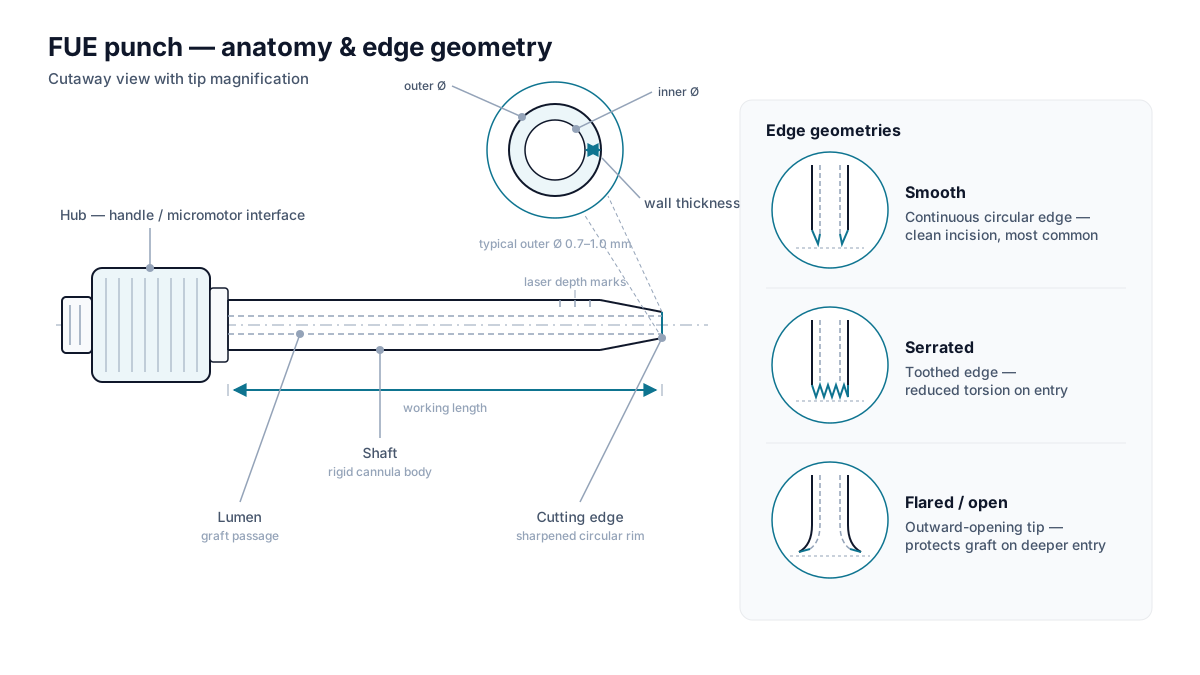
Transection rate is the proportion of follicular units that are cut, sheared, or otherwise damaged during extraction, expressed as a share of the units a surgeon attempts to harvest. It is the standard quality metric for the cutting phase of a follicular unit excision (FUE) case: a lower transection rate means more grafts leave the donor area intact and viable for implantation.
In practice
Transection happens when the punch edge crosses the follicle rather than coring cleanly around it — usually because the punch axis is misaligned with the follicle, because the root splays wider beneath the skin than the shaft suggests, or because the punch diameter is too small for the graft. Because of this, transection rate is watched as a running signal during a case: an operator who sees damaged bulbs on extracted grafts will change punch diameter, adjust depth, or slow the rotation before the pattern compounds across thousands of extractions. Instrument condition feeds directly into it, which is why dull or chipped punches are replaced rather than pushed. The practical levers are covered in the guide to reducing transection and the review of graft damage causes.
What buyers and professionals should know
The single most important caveat is that transection rate is only meaningful once you know how it was counted. A per-graft count records a unit as transected if any part of it is damaged; a per-hair count divides damaged hairs by total hairs, which on multi-hair units produces a very different — usually lower — number for the same tray of grafts. A clinic quoting a figure and a manufacturer quoting one may be measuring different things entirely, so the numbers are not comparable across sources without the method attached. Treat any bare percentage as incomplete information until the counting rule, the sample size, and the operator are specified.
For procurement, this metric is where instrument claims meet reality. A supplier who says their punch "lowers transection" is making an outcome claim that depends on operator technique, donor density, hair caliber, and case conditions — not on the punch alone. Evaluate instruments on measurable specifications such as edge geometry, diameter tolerance, and wall thickness, and treat transection as an outcome the whole system influences rather than a property any one product guarantees. The FUE punches hub collects the specification detail that actually differentiates instruments.