
Why Do Instruments from Turkey Cost Less?
Turkish instrument pricing reflects supply-chain structure — a dense manufacturing and procedure cluster, lower operating costs, currency dynamics and export orientation — not an inherent quality discount.
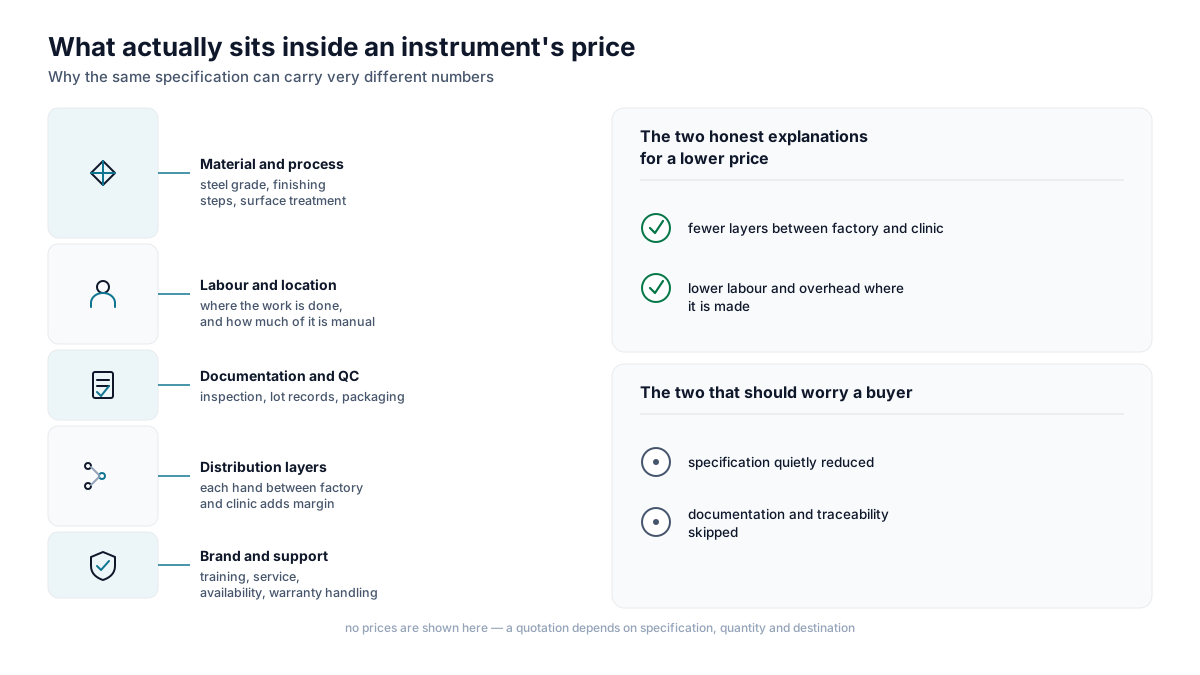
Instruments from Turkey cost less mainly because of supply-chain structure, not because of what they are made of or how carefully. Four factors do most of the work: a dense manufacturing cluster around one of the world’s highest-volume hair transplant markets, a lower labor and operating cost base than Western Europe or North America, currency dynamics that favor export pricing, and an export-oriented industry that competes hard on price to win international buyers. None of these factors is a statement about quality — quality varies between manufacturers in every producing country, and evaluating the specific supplier matters far more than reading the country of origin.
The cluster effect
Turkey — Istanbul in particular — hosts an unusual concentration of hair restoration procedures, and manufacturing follows demand. Where thousands of FUE cases run weekly, an ecosystem of punch grinders, blade makers, implanter producers and consumable suppliers grows up around them, sharing skilled machinists, materials suppliers and rapid clinical feedback. Clusters compress costs in ways no single factory could: shorter development loops, competitive local supplier markets and production volumes that amortize tooling quickly. The same logic explains why German instrument towns or Pakistani forging centers dominate their own niches — geography concentrates competence, and competence at volume gets cheap.
Cost structure and currency
The second factor is straightforwardly arithmetical. Skilled machinist wages, factory rents, energy and administrative overhead all cost less in Turkey than in high-income manufacturing countries, and labor-intensive steps — fine grinding, finishing, inspection, packing — are where instruments accumulate most of their cost. On top of that, manufacturers with lira-denominated costs selling in euros or dollars can quote export prices that would be unsustainable for a competitor whose costs accrue in those same hard currencies. Currency swings cut both ways and pricing shifts over time, but the structural gap has persisted for years.
Export orientation
Turkish instrument makers grew up selling abroad and compete internationally on price as a deliberate strategy for winning first orders from buyers who have never heard of them. An unknown brand cannot charge an established European brand’s premium, whatever its production quality, so aggressive pricing is partly a market-entry cost that manufacturers accept — and partly the absence of decades of brand premium built into the invoice.
What the price does not tell you
The uncomfortable truth for shortcut-seekers: origin is a weak quality signal in both directions. Turkey has manufacturers producing to exacting standards and manufacturers cutting corners; so does every producing country, including the expensive ones. A high price can carry brand premium rather than precision, and a low price can reflect cost structure rather than compromise. What actually predicts your experience is the individual supplier’s consistency — dimensional tolerance, edge quality, packaging integrity, batch documentation, responsiveness when something goes wrong. Those are checkable, supplier by supplier, and the checking method is laid out in the manufacturer evaluation guide.
The practical takeaway for buyers
Treat Turkish pricing as an opportunity that still requires the same diligence as any sourcing decision: request samples, verify specifications against your own measurements, start with small orders and scale with evidence. The savings are real and structural, which means they survive scrutiny — you do not need to skip the scrutiny to keep them. Buyers ready to test the route directly can follow the process in the import from Turkey guide, which covers landed-cost arithmetic, documentation and the first-order sequence step by step.