
Raising a Quality Complaint With a Supplier: A Professional Process
A quality complaint is a professional transaction, not a confrontation: captured evidence, a structured message, a proportionate remedy and a record. How clinics document defects, write complaints suppliers act on, escalate when they stall, and decide when a supplier relationship is no longer worth repairing.
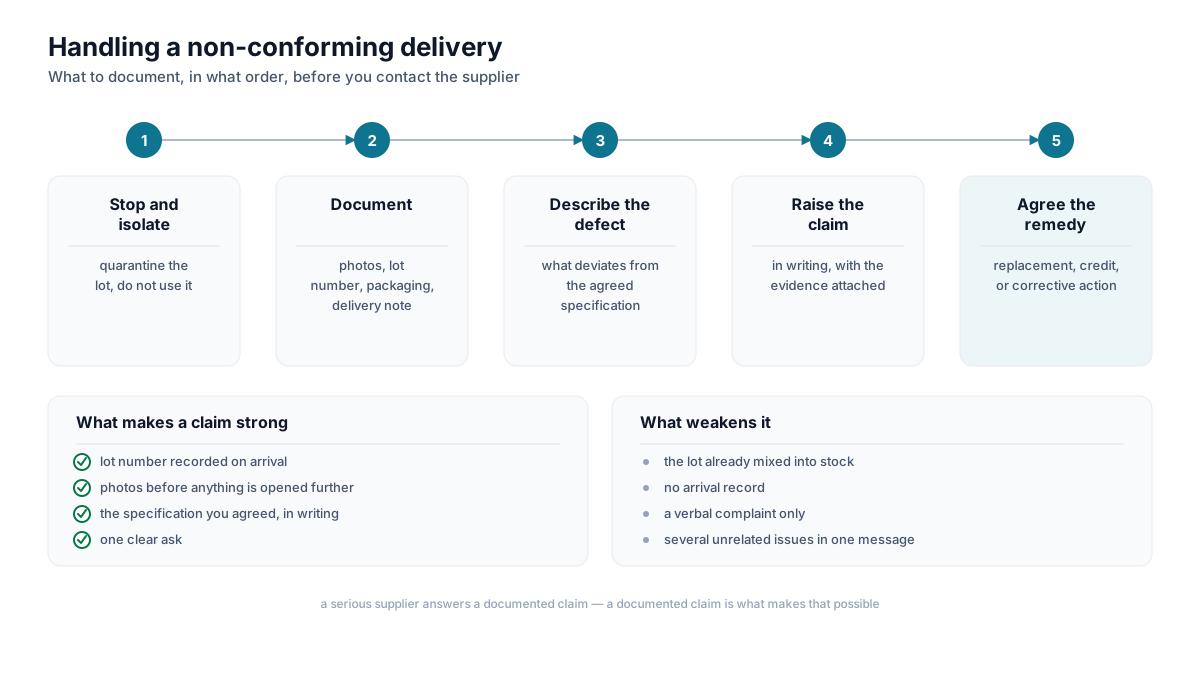
A quality complaint gets action when it arrives as a case file rather than a grievance: the affected product identified by code and lot number, the defect described factually with photographs, the quantity and impact quantified, samples retained for return, and a specific remedy requested with a response deadline. Suppliers triage complaints the way clinics triage patients — the well-documented case with a clear ask gets resolved first, because it can be. The clinic's job is therefore to make the complaint easy to act on, escalate it in defined steps if it stalls, and record every incident so that patterns, not moods, decide when a supplier has to change.
Key takeaways
- Evidence first, always: quarantine affected stock, photograph defects with the lot label in frame, and retain samples before contacting anyone.
- A complaint that names product, lot, quantity, defect, impact and requested remedy in one structured message resolves faster than ten frustrated emails.
- Reasonable remedies scale with the problem: replacement or credit for the goods, plus a corrective-action answer — what caused it and what changes — for repeat or systemic defects.
- Escalate on a ladder with deadlines: sales contact, then quality department, then management, then commercial consequences — in that order, in writing.
- The complaint log is the real product: per-supplier records of incidents and resolutions turn the stay-or-switch decision into evidence.
Why complaint quality determines outcome quality
On the supplier's side of the desk, incoming complaints range from "your punches are bad, send new ones" to a documented case with photos, lot numbers and counts. The first is unactionable: no lot to trace, no defect to reproduce, no way to distinguish a manufacturing fault from shipping damage or a handling issue. The second can move through a supplier's internal process the same day it arrives, because everything the quality team needs to open an investigation is already attached. Serious manufacturers genuinely want the second kind — lot-level defect reports are how they catch a grinding machine drifting out of tolerance or a packaging line seal failing — and a clinic that complains well is training its supplier to take it seriously. Complaint handling is also a supplier-evaluation signal in its own right: how a manufacturer behaves when something went wrong tells you more than any brochure, which is why responsiveness under complaint belongs in how you evaluate an instrument manufacturer from the first sample order onward.
Step one: capture evidence before emotion
The window for evidence is the day the defect is found, and the sequence matters more than speed of complaint. Quarantine first: affected stock is separated, labeled and frozen — nothing gets used, returned to shelf, or thrown away. Then document, in this order:
- Identity. Product code, size or specification, lot or batch numbers from the unit, pouch and carton, order number and delivery date. Lot numbers are the spine of the complaint — a defect without a lot is untraceable.
- The defect, photographed. Sharp photos with the lot label in frame; a scale reference (ruler or a known instrument) for dimensional issues; magnified shots for edge and tip defects. Photograph packaging condition too, since transport damage is a different claim with a different responsible party.
- The count. How many units affected out of how many inspected — "7 of 50 blades from lot X show edge chips at delivery" is a rate a supplier can act on; "several were bad" is not.
- The impact, stated factually. Discovered at incoming inspection, at tray setup, or in use; whether a session was delayed or an instrument switched intra-operatively. Stick to events, not adjectives — impact framed as fact reads as credible, framed as outrage reads as negotiation.
- Retained samples. Keep affected units unused, in original packaging where possible. The supplier will usually want representative samples returned for analysis; the clinic should keep at least one regardless, until the case closes.
Incoming inspection deserves its own sentence: clinics that check deliveries on arrival — counts, packaging integrity, spot checks under magnification for critical sharps — catch most defects while the "at delivery" evidence is unambiguous. Defects found weeks later invite a handling-versus-manufacturing debate that timely inspection would have preempted.
One distinction is worth making before the complaint is written, because it changes the addressee: transport damage is not a quality defect. Crushed cartons, broken sterile pouches on otherwise conforming goods, and temperature-abused shipments are claims against the shipping arrangement — which party bears them depends on the delivery terms agreed at ordering — while out-of-specification product inside intact packaging is a manufacturing claim against the supplier's quality process. Photographing the outer carton before unpacking any suspect delivery preserves the evidence that separates the two, and addressing the right claim to the right party is the difference between a week and a month of resolution time.
Writing the complaint that gets action
One structured message beats a thread. The skeleton that works: a subject line with product and lot ("Quality complaint — 0.9 mm punches, lot 24B117"); one factual paragraph stating what was received, what was found and when; the evidence attached and listed; the affected quantity and order reference; the requested remedy, stated specifically; and a requested response date — a few business days for acknowledgment is a reasonable professional norm. Send it to your sales contact and ask that it be logged with the quality department, which signals familiarity with how manufacturers actually process complaints.
Tone is leverage. The message that assumes the supplier will want to fix the problem — because the good ones do — is easier to act on and harder to deprioritize than the message that opens with threats. Save the pressure for the escalation ladder, where it has structure.
Two smaller crafts help. Ask for a complaint or case reference number in the acknowledgment — it forces the complaint into the supplier's tracked process rather than one salesperson's inbox, and it gives every later message a handle. And keep the requested remedy proportionate to what the evidence currently shows: replacement of the confirmed defective quantity, not the whole order, unless whole-lot doubt is documented. Overclaiming invites the supplier to litigate your weakest assertion instead of fixing your strongest one.
Reasonable expectations: what remedies look like
| Remedy | What it involves | When it is the right ask |
|---|---|---|
| Replacement | Conforming goods shipped against the defective quantity, supplier covers freight | Default for confirmed defects when you still need the product |
| Credit or refund | Value of affected goods credited to account or refunded | When trust in the lot is gone, the need has passed, or replacement timing does not work |
| Return authorization | Structured return of affected stock for supplier analysis | Usually paired with either remedy; expect the supplier to request samples back |
| Corrective action (CAPA) | The supplier investigates the cause and reports what will change to prevent recurrence | Repeat defects, systemic issues (whole-lot problems), or safety-relevant failures |
| Goodwill measures | Expedited replacement, upgraded inspection on future lots, commercial gestures | Negotiated, not owed — reasonable to request after repeated disruption |
Two calibrations keep expectations professional. First, remedies address the goods and the relationship, not consequential drama: a supplier will replace defective blades readily, but claims for the value of a disrupted session live in contract terms and are rarely worth the relationship cost of pursuing — the honest lever for consequential risk is qualifying suppliers well and stocking spares. Second, "CAPA" in plain terms is simply: find the cause, fix it, tell me what changed. Asking for that in plain language on systemic issues is entirely reasonable, and the quality of the answer is diagnostic — a supplier who responds "the operator was retrained" to everything is telling you their quality system is a stamp, not a process.
The escalation ladder
Escalation is a sequence of defined moves, each in writing, each with a deadline — not a rising temperature. If the acknowledgment deadline passes: resend to the sales contact copying the quality department or a named manager, restating the case in one paragraph and setting a new short deadline. If that stalls: a concise message to management level — small manufacturers often resolve at this step in a day, because the principal simply had not seen it. If substance still does not move: attach commercial consequences proportionate to the relationship — pending orders on hold until resolution, payment of the disputed invoice withheld where terms allow it (which is one reason payment terms that leave leverage on the table matter), and the explicit statement that requalification of alternatives has begun. Skipping steps costs credibility; walking them in order, in writing, builds a record that makes the final step — leaving — clean if it comes.
When to change supplier, and the record that decides it
Single incidents, well handled, are not a reason to switch — a supplier who acknowledges fast, replaces without friction and closes the loop with a credible corrective answer has just demonstrated exactly the behavior you qualified them for. The switch signals are patterns: the same defect recurring after a claimed fix, acknowledgment times stretching, remedies arriving only under escalation, or evidence being disputed reflexively rather than investigated. That judgment needs data, which is what the complaint log provides: one line per incident — date, product, lot, defect, quantity, remedy, days to resolution, corrective action received — kept per supplier and reviewed when contracts or annual volumes come up. The log also protects against the opposite error of switching away from a good supplier over one vivid incident while forgetting two years of clean deliveries.
When a switch does come, it runs on the same professional rails as the original sourcing: candidates qualified on samples before volume commitment — the process in the sample orders guide — and the incumbent kept until the replacement is proven, because two mediocre suppliers are not an upgrade on one. And if a complaint investigation reveals that goods were not genuine or arrived through an unauthorized channel, the problem has left the quality lane entirely: verification and response for that case are covered in how to spot counterfeit instruments.
The whole discipline compresses to a sentence: complain like a professional counterparty — evidence, structure, proportionate asks, written escalation, records — and quality complaints stop being disputes and become the mechanism by which good suppliers get better and bad ones get replaced.
Frequently asked questions
What should a supplier quality complaint contain?
Product code and specification, lot numbers from unit, pouch and carton, order reference, a factual defect description with photographs (lot label in frame, scale for dimensional issues), the affected quantity out of quantity inspected, the operational impact stated as events, and a specific requested remedy with a response deadline.
What is reasonable to ask for when instruments are defective?
Replacement of the affected goods or credit, with the supplier covering return freight — that is the standard remedy for confirmed defects. For repeat or whole-lot problems, additionally ask what caused the issue and what will change to prevent recurrence. Consequential costs like disrupted sessions are rarely recoverable and are better managed through spares and supplier qualification.
What does CAPA mean in a supplier complaint?
Corrective and preventive action — in plain terms: the supplier investigates the cause of the defect, fixes it, and tells you what changed. Requesting it is reasonable for systemic or recurring issues, and the credibility of the answer is a strong signal of how seriously the supplier runs its quality process.
How should I escalate if a supplier ignores my complaint?
In defined written steps with deadlines: restate the case to your sales contact copying the quality department, then a concise message to management level, then proportionate commercial consequences — pending orders on hold, disputed payment withheld where terms allow, and visible requalification of alternatives. Walk the ladder in order; skipping steps costs credibility.
When is a quality problem a reason to change supplier?
When the log shows a pattern, not when one incident stings: recurring defects after claimed fixes, stretching response times, remedies only under escalation, or reflexive disputing of evidence. A supplier who resolves single incidents quickly and credibly is demonstrating quality, not the absence of it.
Why keep records after a complaint is resolved?
Because the stay-or-switch decision should run on evidence. A one-line-per-incident log — date, lot, defect, quantity, remedy, days to resolution, corrective action — reviewed at contract or volume decisions shows patterns that memory distorts in both directions, and it protects good suppliers from vivid single incidents as much as it exposes weak ones.
Related articles
How to Evaluate an Instrument Manufacturer
A balanced seven-criterion framework distributors and clinics can use to vet instrument manufacturers before committing a territory or a large order.
Instrument Samples Before a Bulk Order: How Professionals Evaluate
A clinic buyer's guide to sample orders: how to request the exact SKUs you intend to buy, what paid and free samples really signal, a structured evaluation protocol, and how to convert results into a safe first order.
Payment Terms with Medical Instrument Suppliers: Proforma, T/T and LC
How payment actually works when buying instruments internationally: the proforma invoice flow, common T/T split structures, when a letter of credit earns its cost, and the red flags that should stop a transfer.